

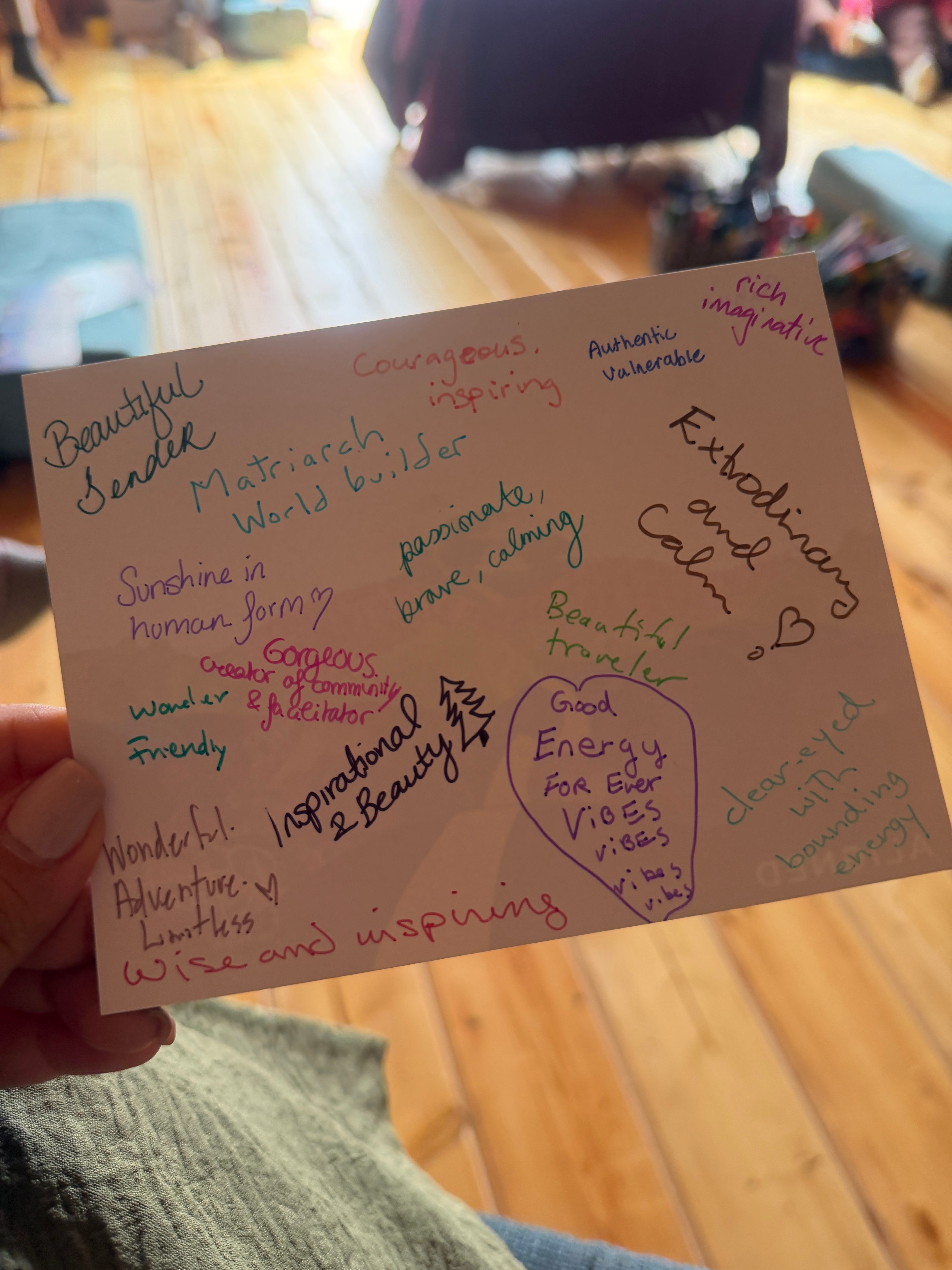
At the end of the retreat, we were each given a card. The invitation was to write a few personal words for every person who had been there.
We had only spent a few days together, but those days had held long conversations, shared meals, laughter, discomfort, creativity, vulnerability, and the kind of connection that forms when people are willing to show up without knowing exactly how they will be received.
I sat with each card and tried to think about what I had noticed. I thought about how they had made the space feel. I thought about the person who made it easier to laugh. The person whose honesty gave other people permission to be honest too. The person whose energy brought warmth into the room. The person who asked thoughtful questions. When I received my own card, I was able to see myself through the words of other people.
It was a beautiful experience. Most of us spend so much time seeing ourselves from the inside. We know the conversations we replay, the ways we think we could have said something better, and the moments when we felt awkward.
Other people do not always see all of that. They experience our presence. They remember whether they could breathe around us. Whether they felt heard. Whether they felt judged or accepted. Reading the card made me wonder how often we think about the experience other people have around us.
We spend a lot of time asking who we want to become. We create goals around our careers, relationships, health, creativity, and personal growth. We think about the life we want to build and the milestones we hope to reach. But we do not always ask: How do I want people to feel when they are with me?
It moves us away from image and toward impact. You can be accomplished and still make people feel small. You can be generous and still make others feel as though they owe you something.
The opposite is also true. You may not always have the perfect words, but people can feel your care. You may not solve someone’s problem, but the way you listen can remind them that they are not alone. We often underestimate these forms of impact because they are difficult to measure.
There is no certificate for making someone feel welcome. Of course, we cannot control how everyone experiences us. Every person sees us through their own history, expectations, needs, and emotions. Someone may misunderstand us even when our intentions are good. The goal is not to manage everyone’s perception.
It is not to become endlessly agreeable, available, or easy to be around. Wanting people to feel safe with you does not mean abandoning your boundaries. In fact, the presence we want to offer others has to include honesty.
There is a difference between making people comfortable and making people feel respected. Sometimes respect sounds like listening. Sometimes it means giving someone space. Sometimes it means setting a boundary without punishing them for having needs.
When someone is around me, do I want them to feel as though they need to impress me, or do I want them to feel that they can arrive as they are?
Do I listen because I am waiting for my turn to speak, or because I genuinely want to understand? Do my actions create the feeling I say I value?
These questions are not always comfortable because our intentions and our impact do not perfectly match. We may value connection while constantly checking our phone during conversations. The purpose of reflection is not to criticize every interaction. It is to notice the space between who we hope to be and how we are currently showing up.
Sometimes other people’s words reveal qualities we have forgotten about ourselves. There are parts of us that become visible through relationship. We cannot always see the effect of our own presence while we are inside it.
That card reminded me that identity is not only built through the stories we tell ourselves. It is also reflected back to us through the people who have witnessed us.
Not every opinion needs to become part of how we define ourselves. But when the same words appear repeatedly, they may be worth paying attention to.
What do the people who know you well consistently say about you?
What do they come to you for?
What changes in a room when you enter it?
What becomes easier for people in your presence?
There is another side to this too.
If you asked the people closest to you how they feel around you, would their answers align with the person you are trying to be?
How do they feel?
Do they feel listened to?
Do they feel free to disagree?
Do they feel that their emotions are safe with you?
Do they feel energized, supported, calm, challenged, accepted, or inspired?
The answer may be different in every relationship. We show up differently depending on how safe we feel, what role we believe we need to play, and what patterns already exist between us. Still, there is value in choosing a few qualities that you want your presence to carry.
I want people to feel that they do not have to perform around me. I want them to feel heard. I want them to know that they can be honest, even when their truth is unfinished. I know I will not create that experience perfectly every time.
There will be moments when I am distracted, impatient, tired, or too focused on my own perspective. There will be conversations I could have handled with more care. There will be times when I realize that what I intended was not what the other person received.
Intention gives us somewhere to return. The card reminded me that the way we move through the world leaves traces.
Long after they forget what we said, they may remember that they felt less alone. They may remember that they were able to laugh. They may remember that, for a moment, they felt seen.
That is a kind of legacy too.
When people leave your presence, how do you hope they feel?
With heart,
Bahar